How to use this module
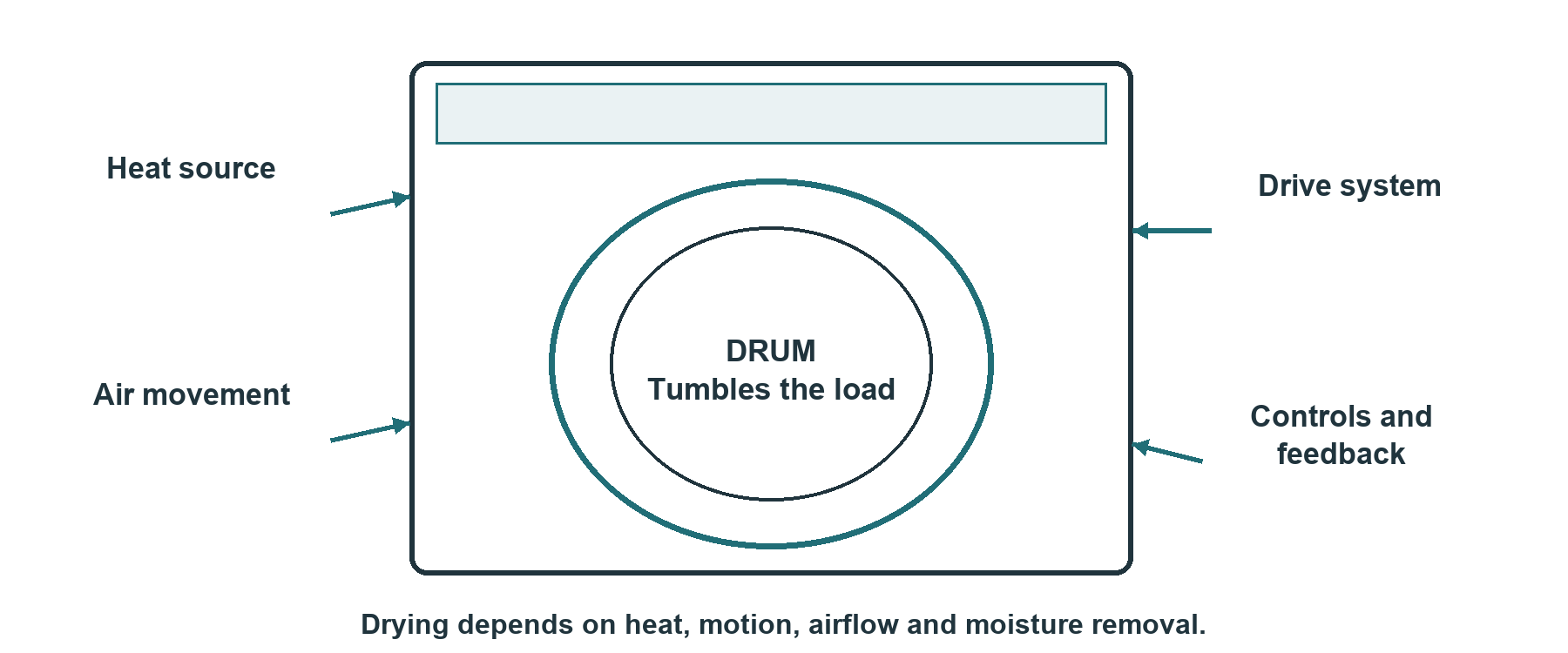
A dryer must transfer energy to the load, move the fabric, and remove the released water. A hot cabinet does not prove effective drying. A turning drum does not prove adequate airflow or available heater power. This module teaches you to separate those observations before deciding what to repair.
Complete Module 0 first. Apply its electrical isolation, moving-equipment and gas-safety principles throughout. Gas work belongs with appropriately qualified personnel. The diagrams explain relationships; exact service instructions govern access, test points, ratings and reassembly.
Learning outcomes
- Identify vented resistance, vented gas, condensing and heat-pump architectures.
- Trace no-heat and overheating complaints through supply, controls, protection and heat production.
- Distinguish a mechanical drive problem from a start-permission or motor problem.
- Evaluate the entire moisture-removal path, including the building exhaust where applicable.
- Interpret moisture and temperature feedback without treating an error code as a parts order.
- Produce a supported estimate and a clear handoff with recorded verification.
| Study stage | Suggested time |
|---|---|
| Architecture and heat systems | 1 hour 45 minutes |
| Drive and moisture removal | 1 hour 15 minutes |
| Sensing controls and model research | 1 hour |
| Examination cases and review | 2 hours |
Six hours is a study estimate, including written practice. It does not establish practical qualification. Any live measurements supplied in an exercise are observations from a qualified technician, not directions for a learner to expose energized wiring. All training prices and numerical examples explicitly labeled fictional are invented for practice.
A useful intake question
Replace “Does it get hot?” with “Which cycle, which load, how wet at the start, how long, and what happens before it stops?” Ask about a recent move, washer spin problems, changed vent routing, unusual smell and the exact model. Record answers before resets or disassembly.
Safety and service boundaries
Before access, identify all energy sources and use the approved isolation procedure. Verify the safe electrical state with appropriate equipment and qualification. A stopped motor or dark display does not establish isolation. Stored electrical energy, sharp sheet metal, hot surfaces and unsupported drums remain hazards after disconnection. [1]
Stop conditions
Gas odor, a carbon monoxide alarm, smoke, visible scorching, damaged supply wiring or uncontrolled heating changes the task from routine diagnosis to making the situation safe. For suspected gas leakage, do not operate switches or attempt ignition. Leave the area and contact the gas supplier or emergency service from a safe location; follow their instructions. Do not resume operation until the hazard has been resolved. [2]
Do not bridge a thermal fuse, defeat a door switch, energize a dismantled dryer for convenience, or use a flame to find a gas leak. Do not demonstrate a vented gas dryer by exhausting combustion products into the room. A customer's signature does not make continued hazardous operation acceptable.
Planning access and restoration
- Record the model, serial, fuel configuration and applicable document revision.
- Confirm that the appliance can be moved without damaging the gas connector, cord, water hose on steam models, drain or exhaust.
- Support removed assemblies and preserve wiring routes, clips, seals and grounding connections.
- Use the manufacturer's approved observation points and operating configuration for any qualified powered test.
- Restore all panels, guards and specified connections before the verification cycle. Gas supply, conversion, pressure and leak checks require the exact instructions and appropriate qualification. Do not infer the fuel from the home's utility service or adjust a regulator to make a poor flame look better. A heat-pump dryer introduces a sealed refrigerant circuit; opening it is outside this module's service exercises.
A customer asks you to fit a fuse and leave the crushed exhaust connection unchanged. What must your response include?
3.1 Identify the drying architecture
The cabinet and plug are clues, not a complete specification. A standard household plug can supply a gas dryer, a compact electric dryer or a heat-pump combination appliance. For example, GE documents a 120-volt ventless heat-pump Combo. Read the rating plate and model literature before choosing a diagnostic path. [3]
| Architecture | How it removes water |
|---|---|
| Vented resistance electric | Electrical resistance heats process air; moist air leaves through an outdoor exhaust. |
| Vented gas | A burner supplies heat; the approved exhaust carries moist air and combustion products outdoors. |
| Condensing electric | Moisture condenses into liquid; air-path and cooling arrangements depend on the design. |
| Heat pump | A refrigeration circuit cools moist air to remove water and reheats process air for reuse. |
Write the architecture at the top of the work order. A ventless machine does not need a building exhaust duct, but still needs its specified clearances, filters and condensate route. A vented machine depends on the building installation as well as internal components.
Supply and a turning drum without heat
Many US full-size resistance dryers use a split-phase supply. The motor and controls may use one line to neutral while the heater uses both lines. Losing part of the supply can therefore leave the drum turning without normal heat. Other designs use different arrangements; the nameplate and schematic decide.
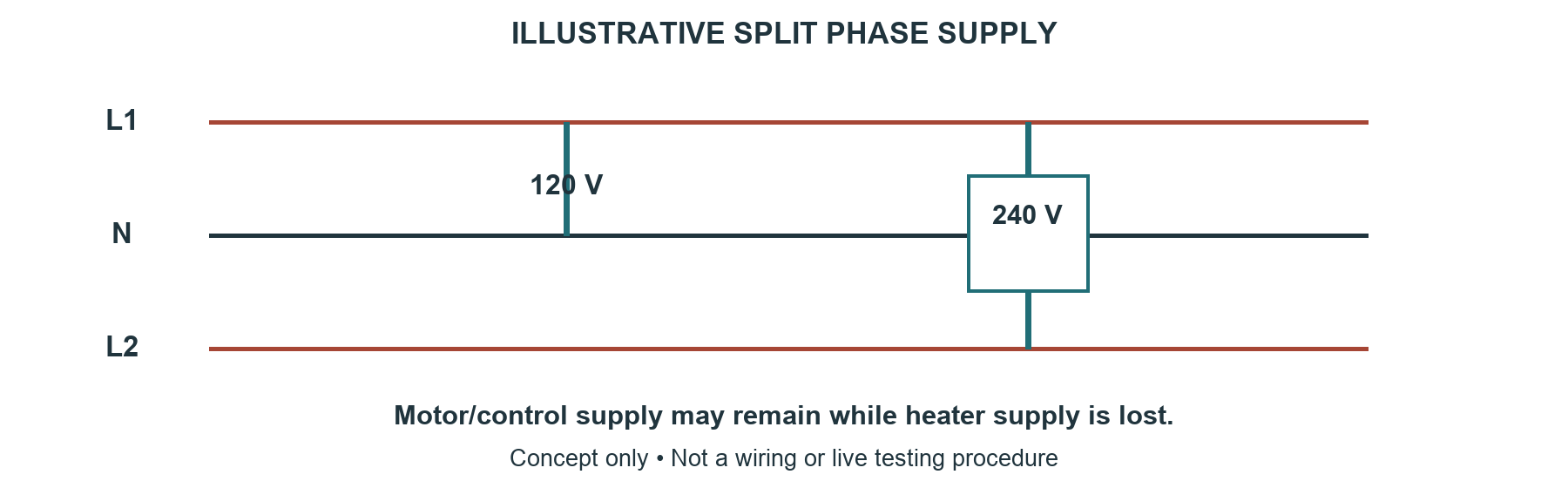
An intake report of “tumbles but no heat” supports several alternatives: incorrect cycle selection, inadequate supply, an open heat path, failed heater, missing motor-run permissive, control output failure or temperature feedback that prevents a heat request. Begin with settings, model identification and safe inspection. Qualified supply verification should precede an expensive speculative parts order.
Do not conclude that two line-to-neutral readings alone prove the required line-to-line supply. A measurement must answer a specific schematic question under specified conditions. Upstream wiring defects belong with the appropriate electrical trade. Heat-damaged terminals require assessment of the connection, conductor and mating components; replacing a cord alone may not correct the fault.
Connection configuration
Three-wire legacy and four-wire connections use different approved bonding arrangements. Never improvise a jumper based on the cord's appearance. Match the appliance instructions and applicable installation requirements. An equipment grounding conductor is not a substitute neutral.
A dryer runs normally in an air-only cycle. Is this evidence that the heater supply is correct?
3.2 Electric heat production
A resistance heater converts electrical energy into heat. Nichrome wire is supported away from the metal housing by insulating parts. Different assemblies may contain one or several separately controlled sections. The schematic identifies which terminals and circuits belong to each section.
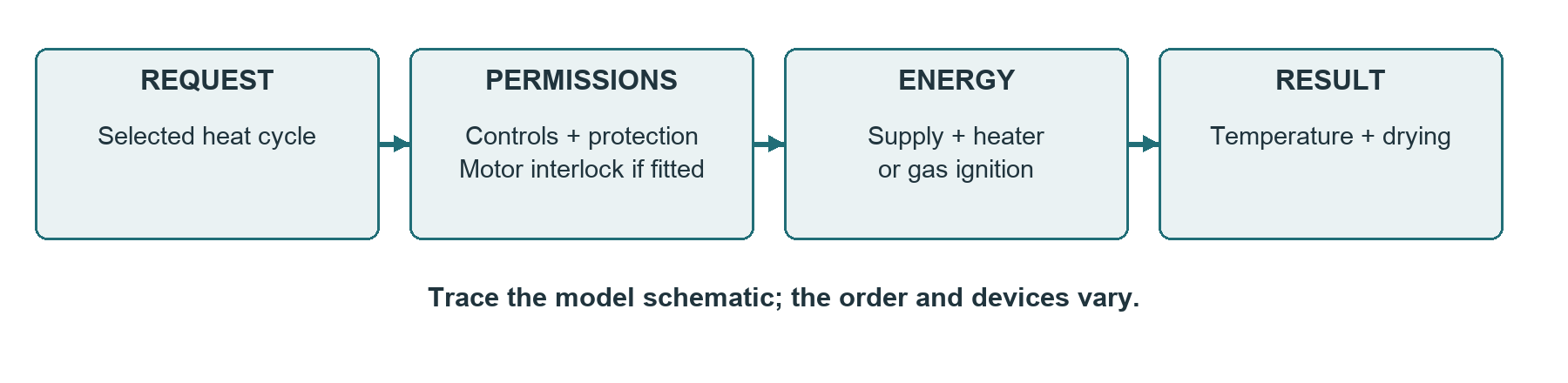
An isolated resistance test can identify an open section. An approved insulation or terminal-to-housing test investigates unintended contact with grounded metal. Neither a visible glow nor a single resistance reading proves that every heater section operates correctly through a full cycle.
For a fictional ideal 240 V, 5,400 W heater, R = V²/P = 240²/5,400 = 10.67 Ω and I = P/V = 22.5 A. These are explanatory calculations using rated conditions, not a universal cold-resistance specification. Wire temperature, manufacturing tolerance and circuit configuration matter. Compare an actual measurement with the model's stated limits.
Interpret the evidence
- An isolated open section supports a fault in that section after meter and contact checks.
- A failed approved insulation test supports a fault requiring correction even if terminal-to-terminal resistance appears plausible.
- A passing static test narrows the search; it does not prove correct supply, switching or behavior when hot.
- Reduced heat on a multi-section assembly requires identifying which section is requested and which is producing heat. A heater touching its housing can produce abnormal heating as well as protective-device operation. Do not assume that every grounded heater must trip the breaker immediately. Uncommanded heating is a stop condition, not an invitation to continue a long drying test.
Thermal protection and temperature regulation
A thermal fuse, thermal cut-off, high-limit thermostat and operating thermostat are different components. Their names are sometimes used loosely in conversation; use the parts list and schematic to determine the actual device. Its position in the circuit determines whether opening it prevents heat, motor operation or another function.
| Device | Diagnostic distinction |
|---|---|
| One-shot fuse or cut-off | Opens irreversibly under its designed conditions; do not bypass or attempt to reset. |
| Resettable limit thermostat | Protective switching with a specified opening and reset behavior. |
| Operating thermostat | Regulates normal heat cycling on applicable designs. |
| Thermistor and controller | Resistance feedback is interpreted electronically; it is not an on-off thermostat contact. |
An open one-shot device requires investigation of airflow, heat control, heater condition, installation and the specified replacement procedure. It does not prove which of those caused the event. Avoid claiming that every failed device must have the same external cause or that another failure is guaranteed within a fixed time.
Some manufacturer procedures require replacing a paired limit with a failed cut-off. Others specify a different assembly or sequence. Follow that instruction rather than replacing every safety component indiscriminately. Whirlpool's cited sheet illustrates distinct fuse, cut-off and high-limit checks and a specified paired replacement for its cut-off fault. [4]
Testing without creating another fault
Use the approved isolated continuity check for a switch-type device, and the specified resistance-temperature chart for a thermistor. Identify auxiliary thermostat-heater terminals separately from switching contacts. A generic hair dryer or heat gun is not a controlled calibration procedure and can damage a device or mislead the test.
The control temperature depends on the sensor location, cycle, load and airflow. A temperature measured at the exhaust is not automatically the heater housing temperature or fabric temperature. Record the location and conditions with every reading.
An open thermal cut-off is found with a clear lint screen. Is the airflow investigation finished?
Gas ignition and heat production
Gas diagnosis begins with identifying the actual ignition system. Conventional residential radiant-sensor systems differ from electronic spark or flame-rectification systems. The following sequence is conceptual, not a wiring diagram or permission to perform gas work.
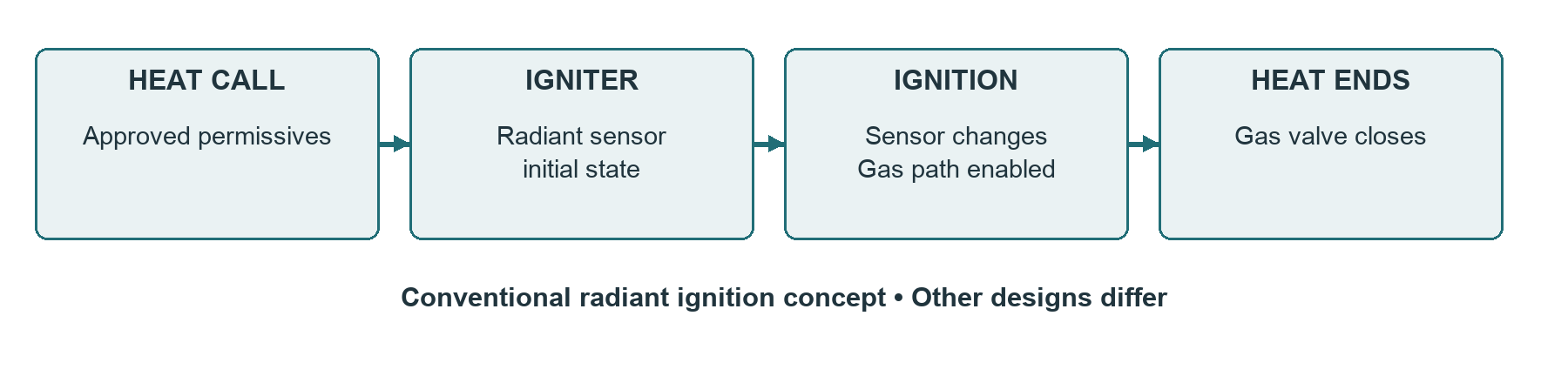
On a conventional radiant system, a heat request with the required permissives energizes the ignition arrangement. The igniter heats; the radiant sensor changes state, allowing the valve arrangement to deliver gas to the hot igniter. During normal burning, flame radiation maintains the sensor's hot state. Removing the heat request closes the gas path. Cooling permits the next sequence. Do not assume the sensor immediately returns to its cold state when the igniter stops glowing. [5]
A valve assembly can contain more windings than its external coil housings suggest. “Booster,” “holding” and “secondary” describe functions within a particular design. Pin pairs can have different resistance specifications. A two-terminal coil and a three-terminal assembly are not interchangeable tests.
Observation must locate the failed stage
Record whether there is a valid heat request, whether the igniter glows, whether its state changes, whether flame appears, and whether the symptom returns after warming. Obtain these observations only through approved access with the appliance in the required operating configuration.
Do not use generic coil resistance, gas pressure or igniter current values. Preserve connector identification before disconnection. Incorrect harness routing near a burner can damage insulation during later operation.
Diagnose the gas sequence without guessing
“Igniter glows but no heat” is incomplete. A continuously glowing igniter and an igniter that glows then goes dark without flame point to different stages. A dryer that heats once and fails on later calls requires a warm-state investigation. A cold coil reading can miss a temperature-dependent fault.
| Observation | Questions that discriminate |
|---|---|
| No igniter activity | Is heat requested and permitted? Are supply, harness, protection and the igniter path correct? |
| Persistent glow without ignition | Does the radiant-sensor sequence match the specified behavior? Is the circuit correctly identified? |
| Glow ends but no flame | Are approved fuel supply and valve checks satisfied? Is an intermittent coil fault present? |
| Flame appears then stops | Did heat demand end, did a limit open, or did valve/ignition performance fail? |
| Abnormal flame soot or odor | Stop operation and escalate to qualified combustion and gas-system diagnosis. |
A short burner run is not proof of a failed holding coil. Restricted airflow may raise temperature rapidly; a control may legitimately end the request; a supply or valve fault may be intermittent. Establish which signal or physical condition changes first.
The repair must restore the approved gas configuration and pass the required leak and operational checks. Changing fuel requires the exact approved conversion parts and procedure. Never enlarge an orifice or adjust a regulator from a generic course value.
Worked reasoning
Fictional observations: the first heat call succeeds. On the next call, the igniter glows and then extinguishes without flame. A qualified technician has verified permitted supply conditions. After safe isolation, one specified coil path fails its warm-state test while its harness passes.
This supports the approved coil or valve repair scope identified by the manufacturer. It does not justify a universal “replace all gas coils” rule. Verification must include repeated heat calls after warming, because a single cold start did not reproduce the complaint.
3.3 Drum drive and support
On many conventional dryers, a motor drives a blower and turns the drum through a belt. Other designs separate those functions. A broken belt may leave a motor running or may open a belt-switch permissive and prevent operation. Sound alone does not establish that the motor shaft is turning.
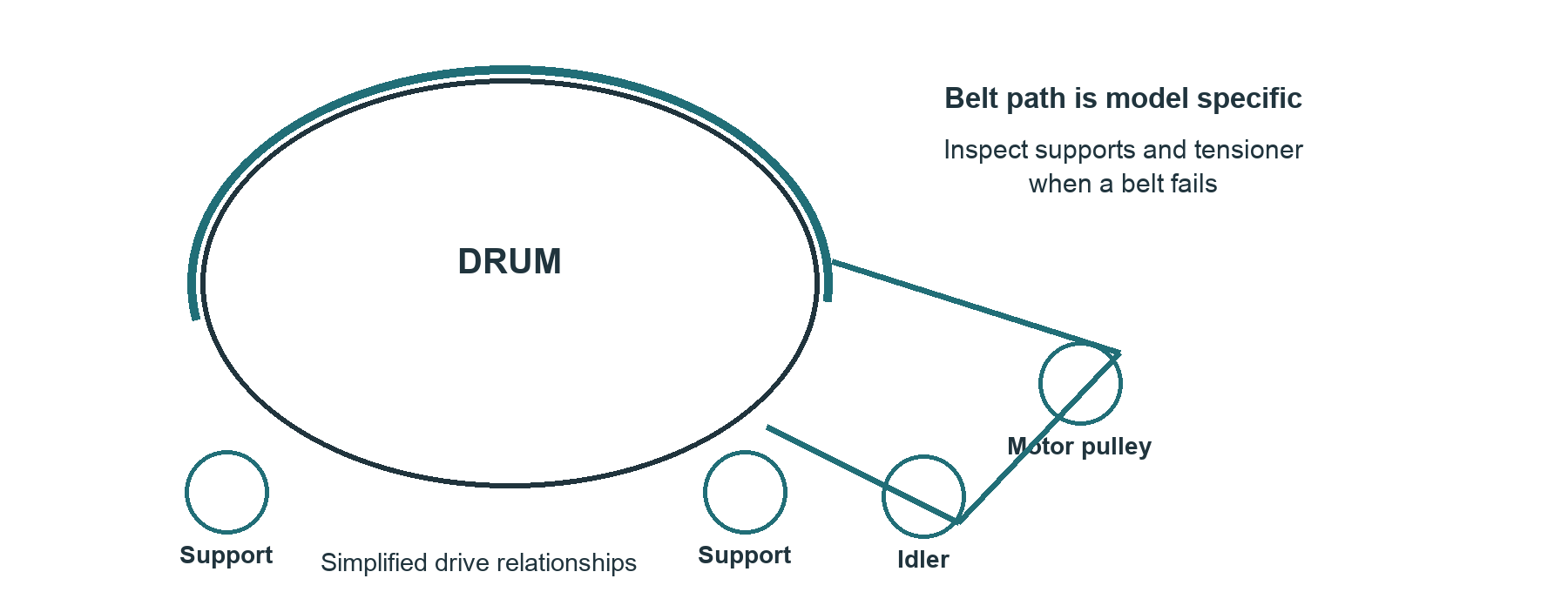
Inspect the whole mechanical path after safe isolation. A failed belt can coexist with a seized idler, damaged support, misalignment or an obstruction. Fitting a belt without addressing the excessive load can repeat the problem. Photograph the approved routing before disturbing a correctly installed assembly.
Rollers, glides, rear bearings and seals have distinct jobs. A felt seal is not automatically a load-bearing shaft bearing. Inspect shafts and mounting points as well as replaceable wear surfaces. Use specified replacement sets where required, and justify optional preventive work separately to the customer.
Do not add oil or grease unless the manufacturer specifies it. An unsuitable lubricant can attract lint, damage materials or contaminate clothing. Route the belt by the actual diagram; similar cabinet widths do not establish identical routing.
The dryer hums without drum motion. Which two categories must remain open before calling the belt failed?
Motors noise and intermittent stops
A conventional motor may have start and run windings, a centrifugal switching mechanism and thermal protection. Electronically driven motors use a different diagnostic method. Identify the architecture before measuring winding resistance or interpreting a switch contact.
An isolated mechanical inspection separates a binding drum, seized support, obstructed blower and motor bearing problem. Use the approved access and support method. A freely turning isolated motor does not prove that it starts correctly under load, and a motor overload opening does not by itself identify a failed motor.
| Symptom | Useful observation before a parts decision |
|---|---|
| Squeal | Exact location and relationship to load, temperature and rotation. |
| Repeating thump | Drum seam, support condition, foreign object or load pattern. |
| Scrape or fabric damage | Clearances, missing glides, seal position and drum-edge condition. |
| Rattle with poor airflow | Blower attachment, broken blades, obstruction and cabinet contact. |
| Stops then restarts after cooling | Supply, mechanical load, motor temperature and protection behavior. |
The blower may use a threaded hub, clamp or other attachment. Do not assume a set screw or a common thread direction. Holding methods and removal direction come from the service procedure; force in the wrong direction can damage the motor shaft or wheel.
Verification after mechanical work
Confirm belt tracking, support fit, unobstructed rotation where safely checkable, wiring clearance, restored seals, lint-path integrity and panel attachment. Then run the approved cycle fully assembled with a representative permitted load. Record noise and motion, not simply “new belt installed.” Check that disturbed exhaust and supply connections remain sound after the dryer is returned to position.
A new roller is fitted but its shaft has a deep wear groove. Why can noise return?
3.4 Airflow and outdoor exhaust
A vented dryer must move enough air through the load and discharge it through the approved outdoor exhaust. Restricted passages, air leaks, weak blower output and unsuitable installation can produce similar long-drying complaints.
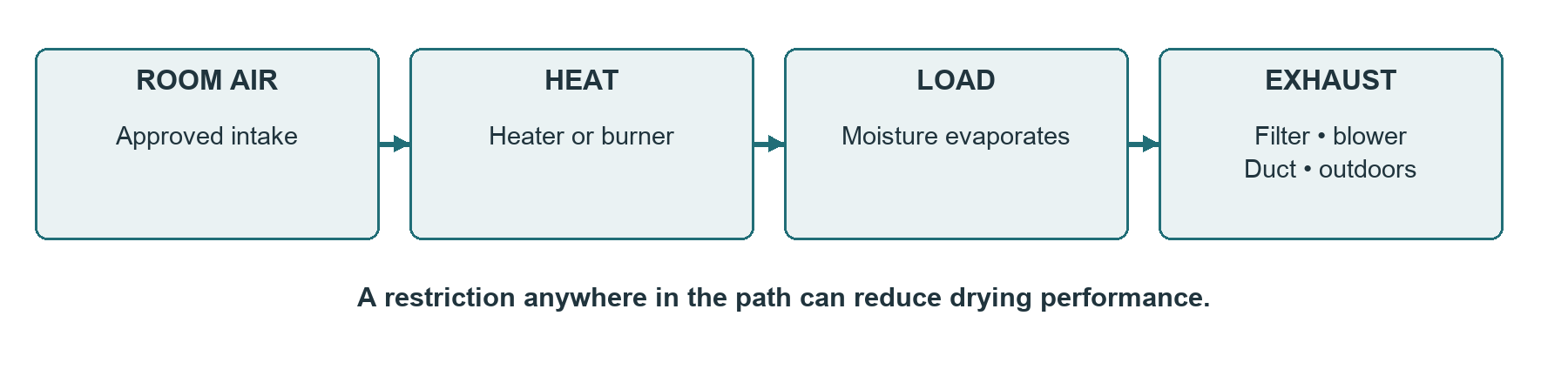
Check the lint screen, its housing, internal passages, blower condition and the entire accessible building exhaust route. A clean screen does not prove a clean duct. A moving outdoor damper does not measure sufficient flow. Lint near the termination is a maintenance clue, not a precise diagnosis of where a restriction lies.
The US Fire Administration emphasizes lint removal and checking for damaged, crushed or restricted venting. Keep this practical message without presenting old national fire statistics as a current annual count. [6]
Use the model's prescribed airflow or pressure test, with the correct instrument location, cycle and comparison limit. Record the measured value and the source of the limit. “Feels weak” can motivate investigation but is weaker evidence than a repeatable approved test.
Do not run a vented gas dryer into the room to demonstrate a restriction. Do not assume a disconnected exhaust test is approved for an electric model either. If a manufacturer permits a controlled diagnostic configuration, follow all its conditions; the normal safe exhaust installation must be restored and verified before return to service.
Exhaust installation and cleaning scope
Installation requirements vary with the dryer, termination, elbows and local rules. Use the actual manufacturer's vent chart. A memorized 35-foot rule or fixed elbow deduction can be wrong for the installation under review. Record what can be seen and identify concealed sections that require further inspection.
| Feature | What to verify |
|---|---|
| Material | Approved metal duct and permitted transition product; no improvised plastic hose. |
| Routing | Length and elbow configuration within the applicable installation requirements. |
| Transition | Not crushed when the appliance is returned to its final position. |
| Joints and supports | Approved fastening and sealing with no inappropriate internal projections. |
| Termination | Correct outdoor discharge, unobstructed outlet and functioning approved damper. |
| Added equipment | Explicit compatibility; do not add a booster fan as a default cure. |
Some current manufacturer instructions expressly prohibit exhaust booster fans. That makes “install a booster for a long run” an unsafe general rule. Verify the exact requirements before proposing any change. [2]
Duct cleaning and appliance repair are related but distinct scopes. The quote should identify which internal passages, transition, building duct and termination are included. Inaccessible or damaged concealed duct may require another qualified contractor. Do not claim a complete clean when only the short transition was serviced.
Cleaning methods must avoid separating joints, damaging the duct or leaving debris downstream. A successful job includes reassembly and verification at the final appliance position. Retain before-and-after observations or authorized photographs and any comparable approved measurements.
Fictional chart exercise
A training installation chart permits 40 equivalent feet and assigns 5 feet per specified elbow. The observed route is 22 feet plus four such elbows: 22 + 4 × 5 = 42 feet. It exceeds that fictional allowance by 2 feet. This arithmetic does not establish any real dryer's limit or authorize a routing modification.
Ventless and heat pump moisture removal
For a heat-pump dryer, the diagnostic question changes from “Can moist air reach outdoors?” to “Can the process-air and condensate systems remove water while transferring heat correctly?” A ventless design still depends on clean filters, airflow, correct drainage and the prescribed installation environment.
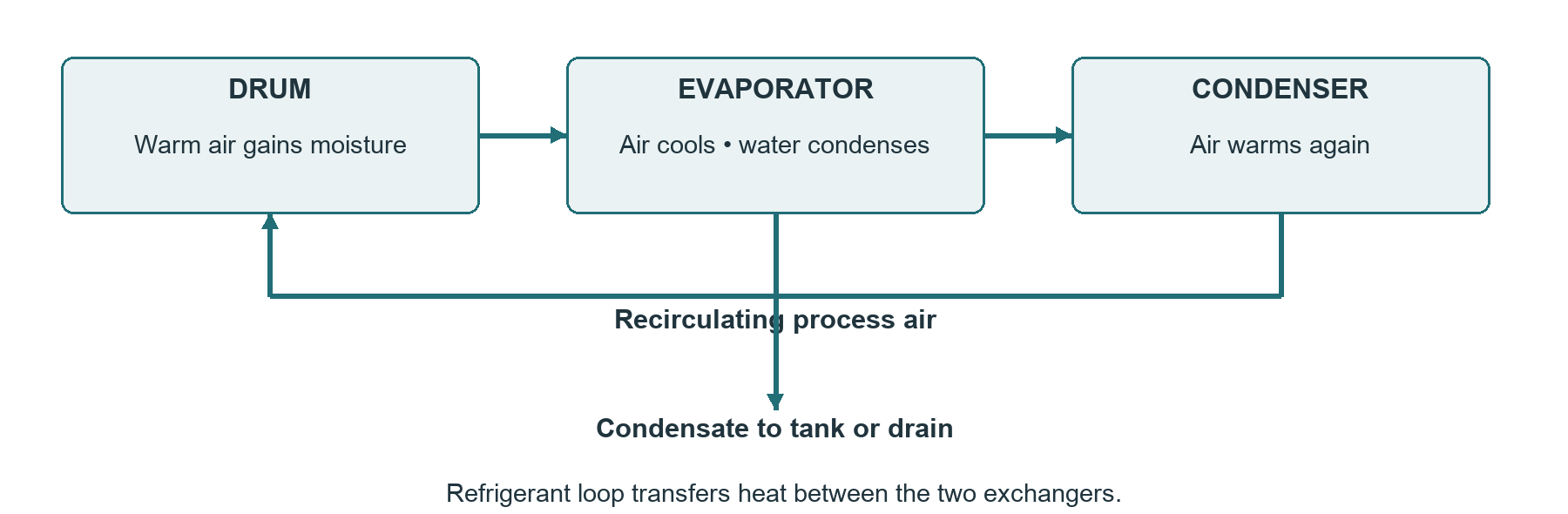
Condensate can collect in a tank or move through a pump and drain arrangement. A full tank, drain obstruction, float condition or pump problem may interrupt drying or create a leak. Follow the model's user-maintenance and service boundaries; not every heat exchanger is intended for removal or brushing by the owner.
Start with the cycle, load, residual washer moisture, filter condition, displayed faults and accessible condensate route. Then use model diagnostics to distinguish fan, pump, temperature-sensor, compressor-control and sealed-system possibilities. A long cycle alone does not prove low refrigerant.
Sealed-system access requires separate training and refrigerant-specific procedures. Do not attach gauges, pierce tubing or add refrigerant to “see whether it improves.” Identify the nameplate refrigerant and the approved service scope before referral.
A ventless dryer stops with its condensate tank full. The customer asks for duct cleaning. What should you explain?
3.5 Moisture sensing
Many sensor dryers use two conductive bars contacted by tumbling clothes. Damp fabric can bridge the bars and change the signal observed by the control. As fabric dries, the signal changes. Actual completion logic may also use temperature, time and other inputs.
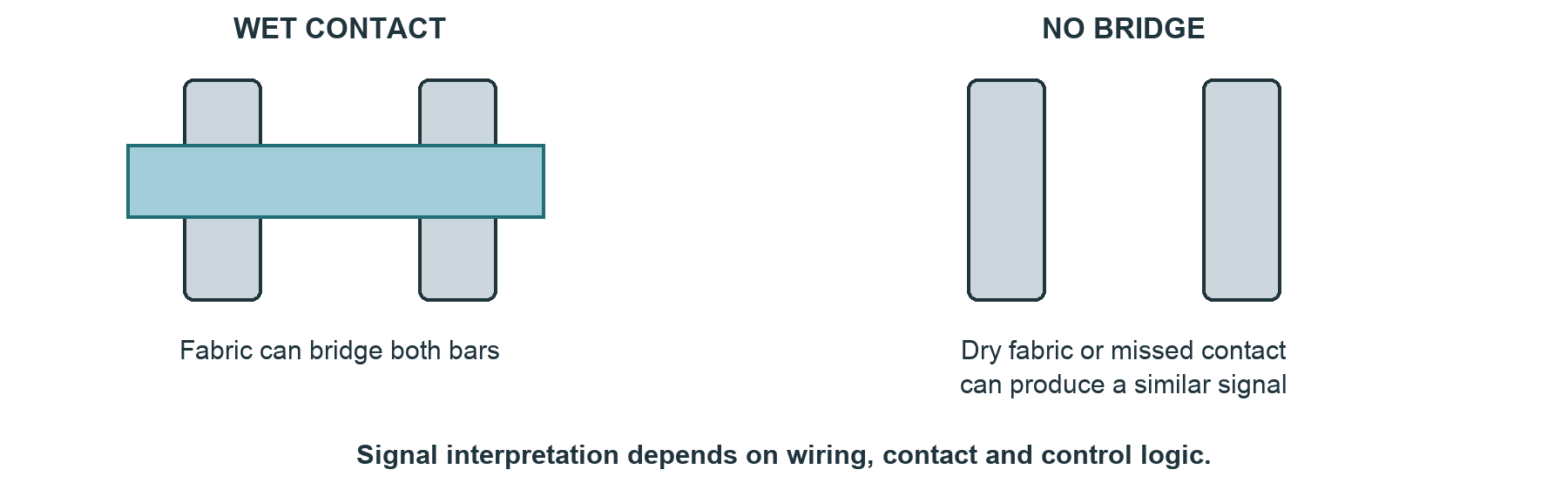
A small load may fail to contact the bars consistently. Insulating residue, an open wire or poor connector contact can also remove expected wet indications. Conductive contamination or an unintended bridge can create a persistent wet indication. The exact fault response depends on the control design; an open circuit does not universally mean “wet forever.”
Use only the approved cleaning method and sensor test. Do not bridge arbitrary connectors or spray solvent into the machine. Inspect bar condition, wiring and the complete path to the control as directed. A bar that looks clean is not proof that the signal reaches the board.
Compare cycles carefully
If a representative load dries appropriately in timed mode but auto mode stops early, examine settings, contact and sensing. That comparison is useful only if heat, load size and starting moisture are comparable. Timed mode is not a safe workaround for overheating or a known exhaust defect.
A sensor cycle that runs long may be responding correctly to genuinely wet clothes. Investigate initial washer extraction, load size, heat production and moisture removal before condemning the sensor. A sensor cycle that stops early can reflect selection or contact rather than a failed board.
3.6 Controls and temperature feedback
The control acts on inputs. A missing heat output may reflect a failed relay, but it may also reflect a valid inhibition, incorrect input or incomplete request. Record the cycle and stage, fault history and operating conditions before clearing anything.
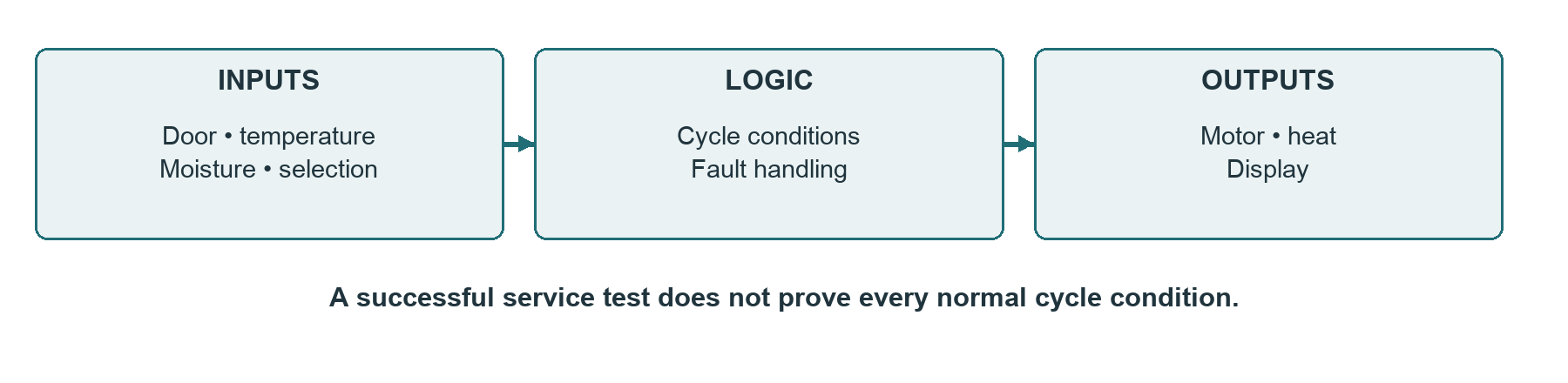
On a mechanical timer, use the contact chart for the exact selected position and appliance state. Some automatic cycles advance differently from timed cycles. An apparently stationary timer is not automatically a seized timer motor. On an electronic control, establish the required supplies, input states and output path before replacement.
Test a thermistor against the specified resistance-temperature chart at a known temperature. Include wiring and connector condition in the investigation. A plausible room-temperature value cannot exclude an intermittent or temperature-dependent fault. A thermistor does not “fail closed” in the same sense as a mechanical thermostat.
Fictional temperature exercise
A training chart specifies 10.0 kΩ ±5% at 25°C. The acceptable interval at that temperature is 9.5–10.5 kΩ. An isolated 12.0 kΩ result, repeated with verified meter contact and confirmed temperature, lies outside the fictional interval. Before applying the conclusion to a real part, obtain its exact chart, units and tolerance.
Service mode can exercise an output under a special set of conditions. Passing that test does not prove every normal-cycle sequence. After a supported repair, reproduce the customer's complaint under the approved comparable conditions.
3.7 From complaint to supported repair
Choose tests for what they distinguish, not because a particular part is rumored to fail often. The first safe checks commonly include settings, model identity, installation and visible condition; the detailed sequence then follows the evidence and manufacturer's diagnostic path.
| Complaint | Separate these possibilities |
|---|---|
| No heat | Selection and supply; heat request; protection; heater or ignition; connections. |
| Long dry time | Initial moisture and load; airflow; heat output; moisture sensing; condensate system if fitted. |
| Will not start | Supply; door/start/control conditions; belt switch if fitted; protection; motor or drive. |
| Motor sound without tumble | Actual rotation versus hum; belt path; binding; drive control. |
| Unexpected heating | Switching fault; feedback fault; heater-to-housing fault; incorrect wiring or assembly. |
| Smell smoke or scorching | Stop and resolve the hazard before further routine operation. |
For each hypothesis, write one observation that would support it and one that would reduce it. This prevents confirmation bias: finding lint does not prove every complaint was caused by lint, just as finding an open element does not prove the exhaust is acceptable.
Explain the venting finding
“The transition is crushed, and the approved airflow test is outside this model's limit. The quote covers correcting that connection and checking the remaining exhaust route. Afterward I will repeat the same test and a permitted drying cycle. If the concealed duct also needs repair, I will explain that additional scope before chargeable work.”
This explanation names evidence, scope and verification. It avoids blame, frightening predictions and unsupported promises. Separate an appliance repair from a building-exhaust referral so the customer knows who must complete each action.
If a hazardous condition remains unresolved, document it and the required next step. Do not return the unit as ready for normal operation merely because the customer declined the recommended correction.
3.8 Model research and parts decisions
Brand knowledge helps locate documentation. It does not establish a failure rate, replacement interval or diagnosis. Similar nameplates may use different manufacturers, support systems, heater assemblies, ignition circuits and software. Exact model and serial applicability control the decision.
| Family or platform | Questions worth resolving |
|---|---|
| Whirlpool built platforms | Which cabinet and drive arrangement? Where are the distinct thermal devices in this circuit? |
| LG and Samsung | Which sensor and drive architecture? What exact code procedure and parts revision apply? |
| GE platforms | Rollers, glides or shaft support? Conventional vented dryer or heat-pump Combo? |
| Frigidaire and Electrolux | Exact support, airflow and control arrangement; applicable service literature. |
| Alliance and Speed Queen | Residential or commercial architecture; actual ignition and control design. |
Avoid translating a washer series name into a dryer architecture. Do not substitute a felt seal for a bearing in a parts explanation. Do not promise a belt will last a stated number of years based only on brand or appliance age.
Before ordering
- Match model, serial range, electrical rating and gas configuration where applicable.
- Confirm the current approved assembly or kit and any required paired components.
- Check the source of the diagnosis and the remaining uncertainty.
- Include seals, fasteners or associated parts required by the repair instructions.
- Explain optional preventive work separately from necessary fault correction.
Research exercise
Select a supervised training dryer. Record its model and find the installation guide, parts illustration and service sheet. Locate the heat source, blower, support design and temperature devices. Identify one way it differs from this module's conceptual drawings. Then describe the exact evidence you would need before quoting its most expensive proposed repair.
Keep a dated model record rather than a list of unsupported brand stereotypes. A useful pattern is a documented symptom, applicable model range, confirming test and approved correction.
Assessment instructions
Complete the 25-question examination and both cases before consulting the answer guides. Each written question is worth one point. A passing score is 20/25. Each case is worth 20 points; earn at least 32/40 across the cases and correct every unsafe proposal before progression.
| Dimension | Four point standard |
|---|---|
| Problem and alternatives | Name the verified complaint and at least three plausible initial causes. |
| Safe sequence | Identify hazards and approved tests that separate the causes. |
| Conclusion and limits | Use the supplied evidence and state what it does not establish. |
| Estimate | Calculate the complete total and apply the fee treatment exactly once. |
| Explanation and verification | Explain scope and repeat the checks needed for the original complaint. |
Score each dimension: 4 = complete and supported; 3 = minor omission; 2 = partly supported; 1 = major gaps; 0 = absent or contradictory. Bypassing protection, operating with an unresolved serious hazard, exhausting combustion products indoors or exposing an unqualified learner to live circuits requires correction regardless of score.
Course policy permits one retake after a 14-day review period. Use missed answers to select the relevant lessons for review. Case observations involving powered or gas-system work are supplied by a qualified technician; learners analyze them on paper.
What to submit
Record your answers and complete the diagnostic and estimate worksheets for both cases. Include an 80–120 word customer explanation for each. Numerical case data and prices are fictional; do not use them as a real estimate or manufacturer specification.
Written examination 1 to 9
Name: __________________________ Date: ______________ Choose one answer per question.
1. A standard 120 V plug on a dryer proves:
A. That the appliance is gas B. Only a supply clue; the model identifies the drying architecture C. That it has no heating system
2. A conventional split-phase electric dryer can tumble without heat because:
A. The motor and heater may use different supply paths B. The motor proves all power is correct C. Every thermal fuse stops only the heater
3. For an ideal 240 V 5,400 W heater, calculated resistance is approximately:
A. 22.5 Ω B. 5.4 Ω C. 10.67 Ω
4. A heater passes terminal-to-terminal resistance. You have established:
A. Its insulation is perfect B. Only that particular static result C. It heats correctly at every temperature
5. An open thermal cut-off requires:
A. The specified repair and investigation of contributing conditions B. A temporary bridge for the customer C. A guarantee that the duct is the cause
6. The motor or heat effect of an open thermal fuse depends on:
A. Cabinet color B. Appliance age only C. Its position in the actual schematic
7. A thermistor should be checked against:
A. Any continuity buzzer threshold B. Its model resistance-temperature chart C. The rating of a nearby thermostat
8. A conventional radiant ignition sensor during normal burning is generally kept hot by:
A. Flame radiation B. The user interface display C. Drum rotation alone
9. Gas valve coil resistance values should come from:
A. A single value for all coils B. The dryer cabinet width C. The exact pin-pair specification
Written examination 10 to 17
Name: __________________________ Date: ______________ Choose one answer per question.
10. A cold coil test passes but heat fails after warming. The cold test:
A. Proves the valve assembly is sound B. May miss a temperature-dependent fault C. Proves the thermostat is failed
11. A humming motor with no tumble establishes:
A. A symptom requiring electrical and mechanical separation B. A broken belt with certainty C. A good motor shaft rotation
12. A broken belt on a design with a belt switch may:
A. Have no effect on starting B. Increase heater power C. Prevent motor operation
13. Before fitting another belt, inspect:
A. Only the timer label B. The tensioner supports and mechanical load C. Only the outside paint
14. Lubricant should be added to supports:
A. Only where and as specified by the manufacturer B. Whenever a part squeaks C. To every belt surface
15. A clean lint screen proves:
A. The entire exhaust route is clear B. The blower is firmly attached C. Only the inspected screen condition
16. To demonstrate a suspected gas dryer exhaust restriction:
A. Exhaust into the room for one load B. Use the approved safe inspection and test procedure C. Remove thermal protection
17. Exhaust length and elbow allowances come from:
A. The applicable installation requirements and model chart B. A universal 35-foot allowance C. A customer estimate of room size
Written examination 18 to 25
Name: __________________________ Date: ______________ Choose one answer per question.
18. A booster fan is:
A. Always required after four elbows B. Always allowed if it improves airflow C. Subject to explicit compatibility and may be prohibited
19. A heat-pump dryer removes water primarily through:
A. An outdoor gas flue B. Condensation and its liquid-water route C. A thermal fuse
20. An open moisture-bar path can resemble:
A. A missing wet-contact signal, depending on control logic B. A universal continuous-wet signal C. Proof of low refrigerant
21. Auto-dry ends early on a very small load. Check:
A. Only the heater wattage B. The gas pressure on every model C. Load contact settings and sensing as well as drying performance
22. A service-mode heat test passes. This establishes:
A. Every normal-cycle condition is correct B. Operation under that particular test condition C. A permanent guarantee of no callback
23. A fictional 10.0 kΩ ±5% specification allows:
A. 9.5–10.5 kΩ at the stated temperature B. 5–15 kΩ at any temperature C. 9.95–10.05 kΩ
24. A $320 repair total includes a $90 diagnostic fee already paid. Balance is:
A. $410 B. $320 C. $230
25. Return-to-service verification should include:
A. Only a picture of the new part B. The original complaint and restored safe installation C. Only clearing the fault history
Case 1 Long drying and a restricted exhaust
Fictional vented electric dryer D-310. A normal towel load now takes two cycles. The customer reports a hotter cabinet since the machine was moved. No smoke, gas service or active electrical damage is reported. Do not operate until the initial safety and installation checks establish permitted test conditions.
Initial task
Name at least three causes. Identify what you would inspect before testing and explain why an immediate heater order is unsupported.
| Supplied check | Result |
|---|---|
| Installation | The transition behind the dryer is crushed. The concealed duct route has not yet been assessed. |
| Dryer condition | A qualified technician finds the heater and specified regulation checks satisfactory. The accessible internal path and blower are sound. |
| Approved airflow test | Under the model procedure, performance is outside its permitted range. No universal numerical limit is supplied. |
| Supported scope | Replace the unsuitable transition, inspect and clean the accessible building exhaust as quoted, then repeat the approved airflow and loaded drying checks. |
| Limit | Concealed damage or a noncompliant route could require a separate contractor and revised authorization. |
Fictional quote
Diagnostic fee $90 is included in the job total and already paid. Approved transition $45; exhaust service labor 1.5 hours at $120; supplies $5. Exclude tax. The quoted scope includes accessible-route inspection, cleaning, reassembly and verification; concealed repairs are excluded.
Your response
- Calculate the total and remaining balance without counting the diagnostic fee twice.
- Explain the evidence supporting exhaust work and what remains uncertain.
- Write an 80–120 word customer explanation. Include the concealed-route limitation.
- Specify the measurements and operating checks needed before return to service. Use the worksheets. Case score: ____ /20.
Case 2 Gas heat fails after the first cycle
Fictional vented gas dryer D-322. The first heat call succeeds. On later calls, the igniter glows and then goes dark without flame. There is no reported gas odor, soot or CO alarm. All gas and powered observations below are supplied by a qualified technician using the exact approved procedure.
Initial task
List at least three alternatives. Explain why an isolated cold-resistance test and a successful first ignition are insufficient to close the call.
| Supplied check | Result |
|---|---|
| Supply and airflow | The qualified technician verifies the specified fuel conditions and permitted airflow. |
| Command and ignition | The later heat request remains valid; the observed sequence matches the documented valve-test branch. |
| Warm isolated check | After safe isolation, one coil winding is open when warm; its connection and harness pass. It returns within the stated range after cooling. |
| Approved repair scope | The manufacturer permits the matched replacement coil kit for this exact valve; the remaining valve assessment passes. |
| Verification need | Repeated heat calls after warming, required leak checks for any disturbed gas connections, and full restored installation. |
Fictional quote
Diagnostic fee $95, not credited against repair charges; approved coil kit $85; labor 1 hour at $130; supplies $10. No payment has been collected. Exclude tax. Comparable installed replacement is $900 for this exercise.
Your response
- Calculate the complete repair total and its percentage of the replacement figure.
- Connect the supported repair to the warm-state evidence. Do not invent generic coil values.
- Write an 80–120 word customer explanation that states the verification plan.
- Explain what you would do if the later heat call still fails after the supported repair. Use the worksheets. Case score: ____ /20.
Worksheet Dryer diagnosis and evidence
Work order: __________________ Model / serial: __________________ Date: __________
Architecture / fuel / source document and revision: ________________________________________________________________________________
________________________________________________________________________________
Complaint cycle load starting moisture and recent changes: ________________________________________________________________________________
________________________________________________________________________________
________________________________________________________________________________
Hazards isolation and approved operating test configuration: ________________________________________________________________________________
________________________________________________________________________________
| Possible cause | Evidence for or against | Test that distinguishes |
|---|---|---|
| ________________ | ________________ | ________________ |
| ________________ | ________________ | ________________ |
| ________________ | ________________ | ________________ |
Test source points instrument conditions specified limit and observed result: ________________________________________________________________________________
________________________________________________________________________________
________________________________________________________________________________
Supported conclusion remaining uncertainty and next action: ________________________________________________________________________________
________________________________________________________________________________
________________________________________________________________________________
Worksheet Exhaust and moisture removal
Model: ______________________ Technician / date: __________________________
Vented or ventless design and applicable installation instructions: ________________________________________________________________________________
________________________________________________________________________________
| Item | Observation and action |
|---|---|
| Lint screen and internal air path | ____________________________________________ |
| Blower and seals | ____________________________________________ |
| Vented transition route and termination | ____________________________________________ |
| Concealed sections and access limits | ____________________________________________ |
| Ventless condensate and filters if applicable | ____________________________________________ |
| Final appliance position and connections | ____________________________________________ |
Approved performance test source and conditions: ________________________________________________________________________________
________________________________________________________________________________
Before result / corrective work / comparable after result: ________________________________________________________________________________
________________________________________________________________________________
________________________________________________________________________________
Unresolved conditions referral and operating disposition: ________________________________________________________________________________
________________________________________________________________________________
________________________________________________________________________________
Worksheet Quote authorization and verification
Customer: ______________________ Work order: __________________________
Confirmed scope exclusions and required associated work: ________________________________________________________________________________
________________________________________________________________________________
| Item | Quantity or rate | Amount |
|---|---|---|
| Diagnosis | ________________ | $____________ |
| Parts | ________________ | $____________ |
| Labor | ________________ | $____________ |
| Supplies / tax if applicable | ________________ | $____________ |
| Complete job total | ________________ | $____________ |
| Included paid amount | ________________ | $____________ |
| Remaining due | ________________ | $____________ |
Customer authorization actual warranty terms and limits: ________________________________________________________________________________
________________________________________________________________________________
Verification conditions cycles measurements and results: ________________________________________________________________________________
________________________________________________________________________________
________________________________________________________________________________
Care guidance referrals and unresolved follow-up: ________________________________________________________________________________
________________________________________________________________________________
Written answer guide 1 to 13
1. B Heat-pump and compact electric designs also exist.
2. A Trace motor and heater paths separately.
3. C R = V²/P; this is not a universal cold-test specification.
4. B Insulation, supply, control and warm behavior remain separate.
5. A Its opening does not identify one universal cause.
6. C Trace the circuit interrupted by that device.
7. B Temperature, units and tolerance must match.
8. A Do not assume it instantly returns to its cold state.
9. C Different windings and designs can have different values.
10. B Reproduce and analyze the relevant operating state.
11. A Sound alone does not prove rotation.
12. C The model permissive arrangement matters.
13. B An uncorrected mechanical fault can damage the replacement.
Written answer guide 14 to 25
14. A Unapproved lubricants can contaminate or damage parts.
15. C The airflow path extends beyond the screen.
16. B Do not discharge combustion products indoors.
17. A Do not generalize a remembered chart.
18. C Some manufacturer instructions prohibit it.
19. B Air recirculates through heat exchange and condensation.
20. A Interpret the actual model signal and fault response.
21. C Intermittent contact can mislead completion logic.
22. B Normal-cycle inputs and intermittency still matter.
23. A Five percent of 10.0 is 0.5.
24. C Subtract the included paid amount once.
25. B Document conditions, results and remaining limitations. Written score: ____ /25. Passing score: 20. Review missed topics and correct unsafe choices before progression.
Case answer guides
Case 1: Exhaust correction
Initial alternatives include starting moisture or load changes, exhaust restriction, reduced heater output and sensing/control problems. A recent move makes the transition especially relevant, without proving the whole diagnosis. Safe inspection precedes operation. The crushed transition and failed approved airflow check support the stated exhaust scope; supplied dryer checks reduce the heater and blower alternatives.
Total: $90 + $45 + (1.5 × $120) + $5 = $320. Included payment: $90. Balance: $230. The uninspected concealed route remains a limitation. Verify the complete restored route, final appliance position, comparable airflow and a permitted representative drying cycle.
Customer model response: “The connection behind the dryer is crushed, and the approved airflow check is outside this model’s limit. The supplied heater and internal-airflow checks do not support a heater replacement. The proposed exhaust work totals $320 before tax; your included $90 payment leaves $230 due. This covers the transition and the quoted accessible inspection and cleaning. Concealed duct damage could require a separate estimate. After the work, I will repeat the airflow check with the dryer in its final position and run the permitted loaded cycle. The dryer should not return to normal use while an unsafe exhaust condition remains.”
Case 2: Temperature dependent coil fault
Alternatives initially include fuel delivery, valve/coil performance, sensor sequence and interruption of heat demand. The supplied warm open winding with a passing harness supports the approved matched coil kit. Cold success does not exclude this intermittent fault. Scope follows the exact manufacturer authorization rather than a universal rule about valve repair.
Total: $95 + $85 + $130 + $10 = $320 before tax. No credit or prior payment applies. Repair ratio: $320 ÷ $900 × 100 = 35.6% rounded. This comparison informs the choice; it is not an automatic repair rule. Verify repeated warm heat calls and restored gas/exhaust integrity. Persistent failure requires renewed diagnosis, explained before additional chargeable work.
Customer model response: “The dryer heated at first, but a valve-coil winding failed its specified test after warming. Its wiring passed, and the manufacturer permits the matched coil kit for this valve. The complete estimate is $320 before tax, including the separate diagnostic fee. That is about 35.6% of the replacement figure used here. After repair, the qualified technician will check repeated heat calls when warm and complete the required safety and installation checks. A successful cold start alone will not close the job. If the original symptom remains, we will explain the next supported diagnostic step before authorizing additional work.”
Quick reference and learning record
| Term | Meaning in this module |
|---|---|
| Heat request | The control state that asks for heat subject to required permissions. |
| Thermal cut-off | A specified one-shot protective device; distinct from a resetting thermostat. |
| Radiant sensor | A heat-responsive device in a conventional ignition arrangement. |
| Moisture bars | Conductive contacts whose signal depends on fabric moisture and contact. |
| Condensate | Liquid water removed from moist process air in a condensing design. |
| Heat pump | A refrigeration system that transfers heat between heat exchangers. |
| Equivalent length | A chart-based method of accounting for duct routing resistance. |
| Intermittent fault | A problem that occurs only under particular conditions such as warming. |
Before closing the call
- The diagnosis follows observed evidence and the correct model procedure.
- All required protection, seals, guards and connections are restored.
- The original complaint was checked under recorded comparable conditions.
- The customer understands the total, maintenance guidance and any remaining referral. Three corrections to my earlier assumptions: ________________________________________________________________________________ ________________________________________________________________________________ ________________________________________________________________________________ Written ____ /25; cases ____ /40; unsafe proposals corrected ____; reviewer / date ____________________. Continue to Module 4 after meeting the module standard.
Sources and further study
Primary references checked September 2026. Bracketed lesson numbers refer to the sources below. Manufacturer literature applies to its identified models and revisions. Original teaching diagrams simplify relationships and do not replace service schematics.
[1] OSHA Electrical work practices
Electrical isolation and qualified-person work context.
[2] Whirlpool Gas Dryer Owners Manual W11679959 Revision B
Gas emergency precautions and model installation requirements, including the stated booster-fan prohibition.
[3] GE UltraFast Combo installation
A documented 120-volt ventless heat-pump example; a standard plug does not establish gas heat.
[4] Whirlpool Tech Sheet W11175222 Revision A
Examples of separate thermal-device tests, model-specific coil pin pairs and prescribed paired replacement.
[5] Alliance Home Dryer Service Manual 512176
Conventional radiant ignition and split-coil/secondary-valve context. Do not generalize to other ignition systems.
[6] US Fire Administration Clothes Dryer Fire Safety
Lint and vent maintenance messages; the workbook does not present a historical fire count as current.
Supervised practice assignment
Use an isolated training dryer to identify the parts represented in the diagrams. With an instructor, map a complaint to an approved diagnostic branch and prepare a work order containing the source, conditions, limits and expected verification. Practical competence requires supervised experience beyond this written module.
Ready for the other five modules?
The complete AR-101 course adds Washers, Dishwashers, Ranges, the Business of Repair, and Sealed Systems with EPA 608 exam prep, plus assessments and apprentice track eligibility. Prefer a quick reference for the truck? Try the Field Diagnostic Kit.
Service Trade Institute · AR-101 Module 3 Dryers · Built from field practice at Appliance Intervention (Mechanicsburg, PA).
Educational use only. This module does not confer electrical, gas, refrigerant, or manufacturer authorization. Follow local code, employer procedures, and manufacturer instructions.